

Meeting Students Where They Are: Experimenting with AI in the Social Work Classroom
Social work professors explore AI use in Capstone course to help students learn from and grapple with AI tools

When MSW students in Capstone (SWO 5395) first opened their course materials, they found something a little different waiting for them: a custom-built AI agent designed specifically for their class, pre-loaded with the syllabus, the NASW Code of Ethics, the Council on Social Work Education's 10 competencies, vetted websites and careful instructions for how to respond.
"The reality is, students are using AI," said Sarah Ritter, graduate program director at the Garland School. "If you ask any faculty member, they're going to tell you their students are using it. We all know it. It's not a mystery."
So rather than fight it, she decided to lean in.
Building the Agent
The tool, built using Microsoft Copilot, functions much like a capstone tutor. Ritter spent time carefully feeding it parameters: what sources it could draw from, what questions it should ask in return and how it should guide students through each stage of the capstone process.
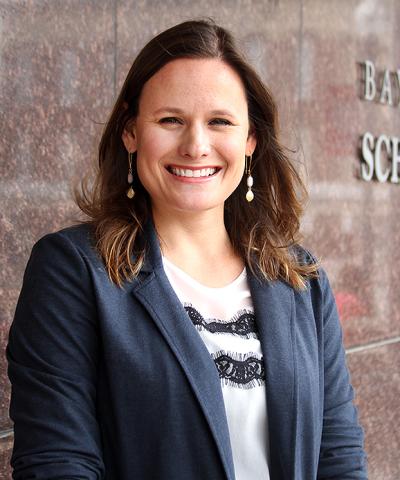
"I told it to only use academic sources, nonprofit foundation websites or governmental websites when giving responses," she explained. "So, if a student is asking about trauma-focused CBT for justice-involved youth, the sources it pulls are going to be from those categories, not just anywhere on the internet."
The agent also doesn't just answer students’ questions. It asks clarifying questions back.
"If a student asks, 'Tell me more about trauma-focused CBT for juvenile justice-involved youth,' the agent will respond, but it will also ask: Do you want follow-up questions? Do you want to know about ethical considerations?" Ritter said. "I've also plugged in the NASW Code of Ethics and CSWE competencies, so it naturally pulls those in when it's relevant."
Students can use the agent at nearly every stage of their capstone — from brainstorming a topic and building an outline to drafting a CEU abstract and preparing their final presentation slides. The one exception? The annotated bibliography.
"They have to read the sources and write a critical summary themselves," she said. "There's really no way you get out of learning a lot about your topic. You won't be knowledgeable enough to answer questions during your presentation if you haven't actually done the reading."
More Than One Tool
The capstone agent is just one piece of a broader set of AI tools Ritter introduced to her students this semester. She also taught them to use Scopus AI, an academic research tool offered through Baylor Libraries that helps students navigate peer-reviewed journals with greater efficiency.
"Scopus AI gives you little abstract summaries on the side so you can quickly tell if something applies to your topic — instead of reading a full article and then having to go search for another one," she said. "It also tells you who the most-cited scholars are in a field, which is something students don't always know off the bat because they're not yet experts in their topics."
She most recently introduced students to Box Hubs, a tool that allows users to upload their research documents and then ask specific questions across all of them at once.
"If a student has already gathered all their articles and they want to know which ones address ethical considerations for treating justice-involved youth, Box Hubs can pull out the relevant summaries and cite the articles," she said. "So, then they can go directly to those specific articles and know exactly where to look when building that section of their presentation."
Honest Conversations About AI
One of Ritter's central goals for the pilot wasn't just efficiency. It was honesty.
"We've had such a culture of 'you better not use AI' that students have ended up using it but feeling ashamed about it," she said. "My hope in this class was to have a more honest conversation. How do we acknowledge our AI use? How do we integrate it ethically, while still actually learning the material?"
That conversation also includes the limitations of the technology itself. She's been upfront with students about how imperfect AI can be ... sometimes partially accurate, sometimes completely wrong.
"I tell them, you can use it to help with citations, but it will be wrong," she said. "It doesn't replace you having to double-check. It saves time, but you still have to verify the information."
And for students who came in skeptical, some citing environmental concerns about the energy and water demands of AI data centers, Ritter didn't dismiss those reservations.
"We've had such a culture of 'you better not use AI' that students have ended up using it but feeling ashamed about it," Ritter said. "My hope in this class was to have a more honest conversation. How do we acknowledge our AI use? How do we integrate it ethically, while still actually learning the material?"
"I think students and social work professionals are right to be concerned about the environmental impact," she said. "We care about environmental justice. But I also think we can't throw out the good with the bad. We have to be willing to think about how we use AI ethically — for our clients, for our communities — while also advocating for stronger policy and regulation of AI companies."
She also makes it clear to students that AI use is not required for any of the work in the class. Students can opt out of using it.
Leveling the Playing Field
Using AI in the classroom isn’t always just about the technology, Ritter noted what it can mean for students who have historically faced additional barriers.
"AI could be a game changer for historically under-resourced students," she said. "It helps with writing, with grammar, with building a PowerPoint. If someone comes from a background where those skills weren't taught in the same way, AI can help them communicate their knowledge and intelligence more effectively. It can level them up."
She draws a parallel to tools like Grammarly. Grammarly is not as a replacement for a student's own voice, but it’s a resource that makes quality more equitable.
"Your knowledge, your intelligence, your information can get communicated in a way that makes it more equitable," she said.
Waiting on the Data
The pilot program, which Ritter is running alongside Garland School colleagues Drs. Elissa Madden and Geneece Goertzen, will be evaluated at the end of the semester through anonymous student surveys. The team is genuinely curious about the questions asked on the survey: Was the agent helpful? Did it create more work than it saved? Was Scopus AI more useful than Box Hubs? Were students honest about when and how they used the tools?
"We may get to the end and say, this course was the same [as without AI], and we don't want to do it again," she said. "But part of the challenge with new technology is that we have to be willing to try new things. In academia, we can be very attached to the idea that we have the right way. But students are getting out into a world where AI is being used, and we have to adapt. This train is not stopping, and we have to decide what we do with it!"
Looking ahead, the team hopes to present findings from the pilot and is exploring possibilities for publication.